
Emergency Air Duct Cleaning Near Me: What Carrollton Homeowners Should Do First
If you’re smelling something burning from your vents, calling a duct cleaner is the third call you should make, not the first. That order matters for both your safety and your wallet. Most “duct emergencies” in Carrollton turn out to be one of four things: a burning smell with a mechanical cause, visible growth at a register, water that got into the system after a storm, or evidence that something has been living in the ductwork. Each one has a different first move, and only some of them end with a cleaning crew at your door. Here’s how to sort out which one you’re dealing with before you spend money on the wrong service.
If you’d rather not work through the checklist yourself, call (866) 580-7041 and we’ll help you figure out what you’re actually looking at.
What does “emergency air duct cleaning” actually mean?
Honest answer: for most duct cleaning companies, it doesn’t mean much. A real negative pressure cleaning job takes equipment setup, containment, and a crew that knows how to run both. Rotobrush rotary brushes and Nikro vacuum systems aren’t something you roll out of a van in ten minutes for a same-day call. When a company advertises emergency duct cleaning in Carrollton, that’s usually a phone number, not a process.
What a real urgent response looks like is different. It’s someone picking up the phone and asking what you’re seeing and smelling, then telling you whether you need a cleaning crew at all or whether you need an HVAC technician or a plumber first. That conversation should happen before anyone quotes a price. We answer 24/7, and crews dispatch from 7am to 7pm Sunday through Friday. That’s not the same as promising a negative pressure cleaning on an hour’s notice, and no one who owns this equipment will promise you that.
So when you search for emergency air duct cleaning near me in Carrollton, what you should really be shopping for is triage. Someone who will tell you the truth about whether your problem is a duct problem at all.
Your triage checklist: match the symptom to the first call
Start with what you’re noticing, not with who to call. The symptom tells you the first move, and the first move is often not a duct cleaner.
- Burning smell from the vents. First call: your HVAC technician, or 911 if there’s smoke or a hot smell that won’t clear. A burning smell means something mechanical is overheating or a component has failed. Cleaning ducts around a failing component doesn’t fix the failure and can hide it.
- Visible mold or dark staining at a register. First call: whoever can find the moisture source, which may be your HVAC technician or a roofer. Mold needs water. Cleaning the visible growth without finding the leak that fed it means it comes back.
- Water intrusion after a storm. First step: stop the system, document everything, and get the space drying. Cleaning wet ductwork before it’s dry is the wrong order (more on this below).
- Vermin evidence: droppings, gnaw marks, nesting material. First call: pest control, then a duct repair specialist. Animals get into ductwork through gaps, and cleaning without sealing the entry point is a revolving door.
- Sudden airflow loss with no smell or moisture. First call: your HVAC technician. Collapsed or disconnected duct runs, a failing blower, or a blocked coil can all look like a duct cleaning problem from the register side. Only an inspection tells you which one it is.
That last point matters more than people expect. Cleaning ductwork when the real problem is a mechanical failure doesn’t just waste money. It can mask the failure long enough for it to get worse, and it can create a liability question if a technician later finds damage that a cleaning crew worked around without flagging it. If airflow dropped suddenly and there’s no smell involved, get the mechanical side checked before anyone touches the ducts.
When should you call an HVAC tech before a duct cleaner in Carrollton?
More often than the duct cleaning industry likes to admit. Here in Carrollton, a lot of homes run their systems hard through long, hot stretches, and the symptoms of an overtaxed air handler and a dirty duct system can look identical from the living room. Reduced airflow, dust settling faster than usual, a musty smell that only shows up when the system runs: all of these have more than one possible cause.
Call an HVAC technician first when:
- The airflow dropped suddenly rather than gradually. Gradual decline points toward buildup; a sudden drop usually points toward a component or a collapsed run.
- You hear rattling, scraping, or a motor sound that wasn’t there before.
- There’s any burning or hot smell. This one is non-negotiable. Shut the system down at the thermostat and get a technician out.
- The system short cycles or won’t keep up the way it used to.
Call a duct specialist first when the symptoms are gradual: dust that keeps coming back, musty odors that track with the system running, visible debris at registers, or a system that hasn’t been cleaned in years and is now noticeably less efficient. That’s a duct pattern, not a mechanical one.
When the answer really is ducts, we clean it, and if it needs repair, we fix it on the same visit. Rotobrush and Nikro equipment handle the cleaning; if the crew finds a disconnected run or a crushed section behind a wall, that’s duct repair work we can do rather than something you have to book out to a third company. We also work alongside Honeywell and Aprilaire systems, so if you have whole-home filtration and we’re opening the system anyway, the two jobs get coordinated instead of fighting each other.
After a flood: what Carrollton homeowners get wrong
Carrollton’s storm pattern matters here. When heavy rain moves through and dumps a lot in a short window, flat lots and older drainage can send water places it shouldn’t go, and ductwork sitting in a crawlspace or running near an exterior wall is a target. The mistake homeowners make is calling for cleaning the day after the water recedes.
Mold needs a window, and the window is short: roughly 48 to 72 hours after moisture gets into the system. Cleaning wet ductwork before it’s dry doesn’t remove the problem. It spreads moisture and whatever is already growing, and then you’re back to square one in a few weeks. Drying comes first. Always.
The order that works:
- Stop the system. Don’t run the air handler while there’s moisture in or around the ductwork. Running it distributes the problem.
- Document everything. Photos of standing water, water lines on ductwork, damp insulation, and any visible growth. Timestamp your pictures.
- Dry the space before anything else. Fans, dehumidification, whatever the situation calls for.
- Then book the inspection and cleaning.
On the insurance side, documentation is what carries your claim. Water lines, wet insulation, and dated photos of the affected runs are the things adjusters ask for, and they’re nearly impossible to reconstruct after the clean-up. Take the pictures before anyone touches anything.
How to contain the problem yourself while you wait
Nothing here requires tools, and none of it is a substitute for professional service. It’s about keeping a bad situation from getting worse while you sort out who’s coming.
- Shut the system down at the thermostat. If there’s a burning smell, visible moisture, or anything growing, the system stays off until someone qualified looks at it.
- Seal the registers in the affected area temporarily. Painter’s tape and plastic film will do it. This keeps the system from pushing air through a compromised section if it gets switched back on by accident.
- Turn off the air handler itself if you can reach the switch safely. Many units have a service switch nearby. If it’s not obvious or not safe to reach, leave it alone. The thermostat is enough.
- Open windows in the affected rooms if outdoor conditions allow. Ventilation helps while you wait.
- Don’t run a shop vac in the ductwork. Consumer vacuums don’t capture fine particulates, they redistribute them. If you’ve been thinking about it, put the vacuum down.
One thing we hear a lot: “I taped everything off and the smell’s gone.” Sealing registers hides the symptom. It doesn’t fix what’s behind the wall. It does buy you time, though, and time is what you need to get the right person out rather than the first one who answers.
What a professional response actually looks like
When a crew shows up, the first thing to watch is containment. Dislodged particulates have to be captured, not recirculated into your living room. That’s why we use Abatement Technologies air filtration and containment equipment on every job. If a crew arrives without containment equipment and starts pulling debris out of a register, that’s your cue to stop the work.
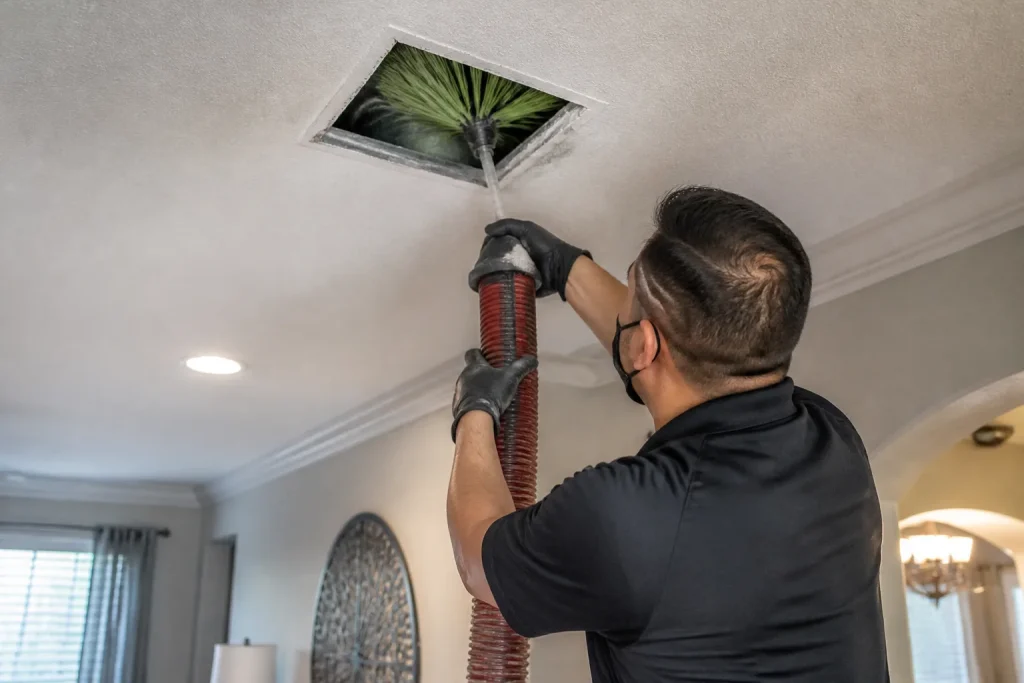
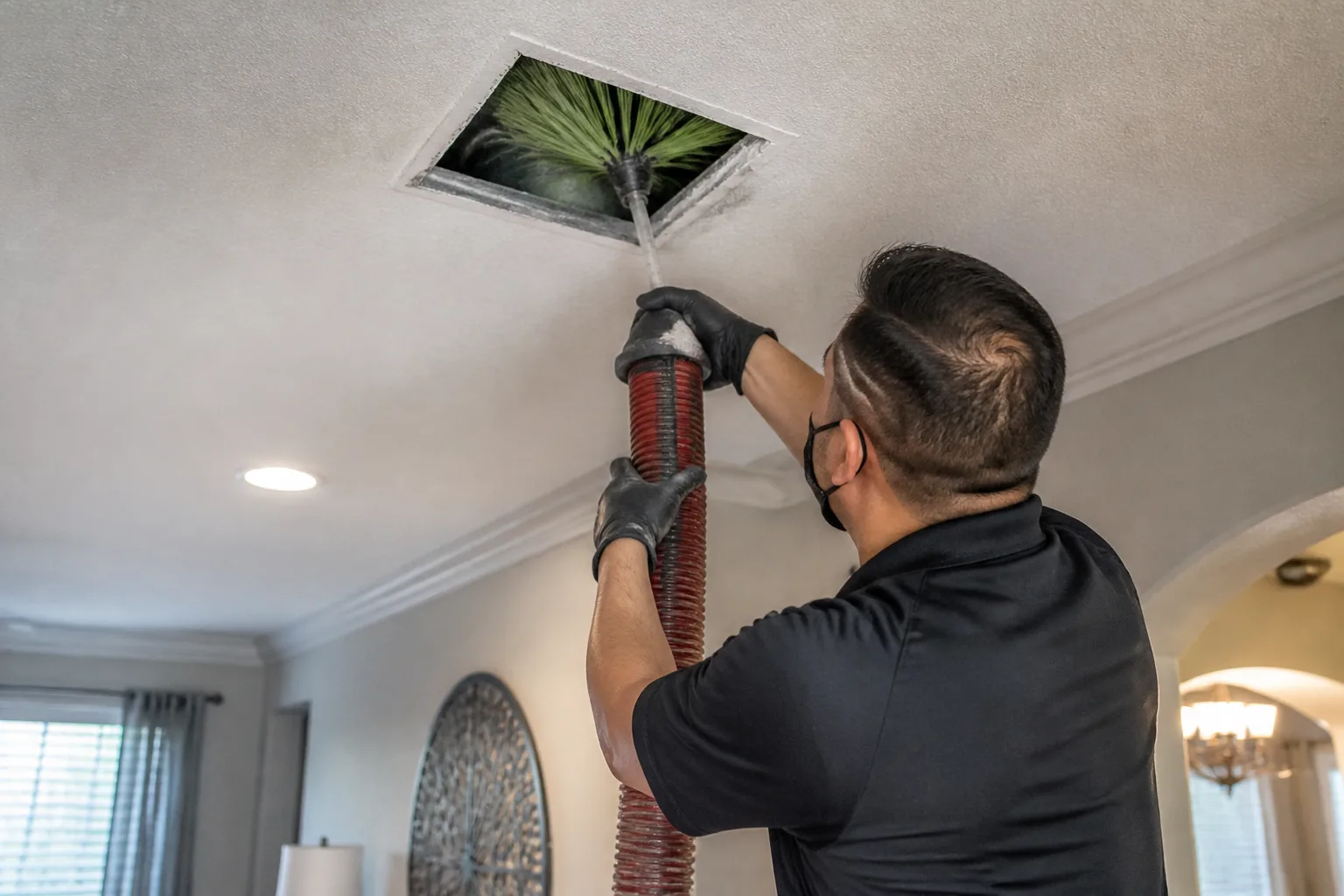
Second thing to watch: equipment. Rotobrush and Nikro are the systems used in commercial duct cleaning for good reason. They do the job properly. A consumer-grade vacuum with a long hose is not the same tool, and you can tell the difference on sight.
Third: before-and-after photos of your own ducts. Not stock images, not a printout of someone else’s job. Yours. Ask for them if they’re not offered. If the crew can’t show you what they found and what they left behind, you don’t really know the work was done.
Fourth: pricing. One flat price per system, agreed before work starts, is the standard this industry should be held to. Per-vent pricing is where quotes balloon, and it puts the incentive in the wrong place.
For more on how a standard air duct cleaning visit is structured in a Carrollton home, and for what our duct cleaning Carrollton crews bring to each type of job, those pages go deeper.
Related services in Carrollton
Fire risk travels through the same wall cavities as your ductwork, which is why our dryer vent cleaning work gets the same systematic treatment as trunk line cleaning. If you’re already scheduling a crew, it’s worth having both looked at. And if your problem turns out to be a damaged run rather than accumulated debris, air duct repair may be the actual fix. For a broader look at how these services fit together across Carrollton, we’ve laid it out by neighborhood and housing type.
What happens when you call
- 1
A real person answersNo phone trees – you reach a local pro.
- 2
You get an upfront price rangeHonest numbers before anyone is dispatched.
- 3
A background-checked tech heads outLicensed & insured, dispatched right away.
- 4
You approve before work beginsNothing starts until you say go.
The Bottom Line
The sequence is what saves you money. Burning smell: HVAC technician first. Water: dry first, document everything, then clean. Mold or vermin: find the source before you clean. Gradual dust and odor: that’s a duct cleaning call.
- Burning or hot smell means shut the system down and call a technician.
- Wet ductwork has a 48-72 hour mold window. Dry first, always.
- Document water damage in photos before anything gets moved. Insurance claims live and die on documentation.
- “Emergency duct cleaning” is mostly a marketing term. Real urgent response is a phone call where someone tells you the truth about what you’re looking at.
- Whoever shows up should arrive with containment equipment, professional-grade tools, and a flat price agreed in advance.
If you’re in Carrollton and need help, Duct Cleaning Carrollton offers free estimates. Call (866) 580-7041. We answer 24/7, with fast dispatch from 7am to 7pm, Sunday through Friday. We’re closed Saturday; if you reach us outside dispatch hours, we’ll book you into the next opening. We’ve been serving Carrollton since 2012.
Frequently Asked Questions
Sometimes, but not on demand, and any company that promises it without asking you a single question is telling you what you want to hear. Real duct cleaning requires negative pressure equipment and containment setup. What we can do same-day is triage: find out whether your problem is a duct issue or a mechanical one. Call (866) 580-7041 and we’ll start there. Estimates are free.
Shut the system off at the thermostat and call an HVAC technician, not a duct cleaner. A burning smell usually points to a mechanical or electrical issue, and cleaning ducts around a failing component doesn’t fix it. If there’s visible smoke or a hot smell that won’t clear, get out and call 911. Once a technician has checked the system, we can talk about whether the ducts need attention.
Roughly 48 to 72 hours from the moment moisture enters the system. That’s the window before growth gets established, which is why drying comes before cleaning without exception. Document the damage with dated photos first, then dry the space, then book the inspection. Cleaning wet ductwork spreads the problem instead of solving it.
Usually because something is missing: containment equipment, professional-grade vacuums, or the time to do the job properly. Per-vent pricing and teaser coupons tend to grow once the crew is in the house. One flat price per system, agreed before work starts, with before-and-after photos of your own ducts at the end, is the standard worth holding to. Call (866) 580-7041 for a free estimate and a straight answer on what your system needs.
Written by the team at Duct Cleaning Carrollton, serving Carrollton since 2012.
Need Air Duct Cleaning Help?
Call Duct Cleaning Carrollton - licensed & insured, here with fast help in Carrollton.
(866) 580-7041